Promo !

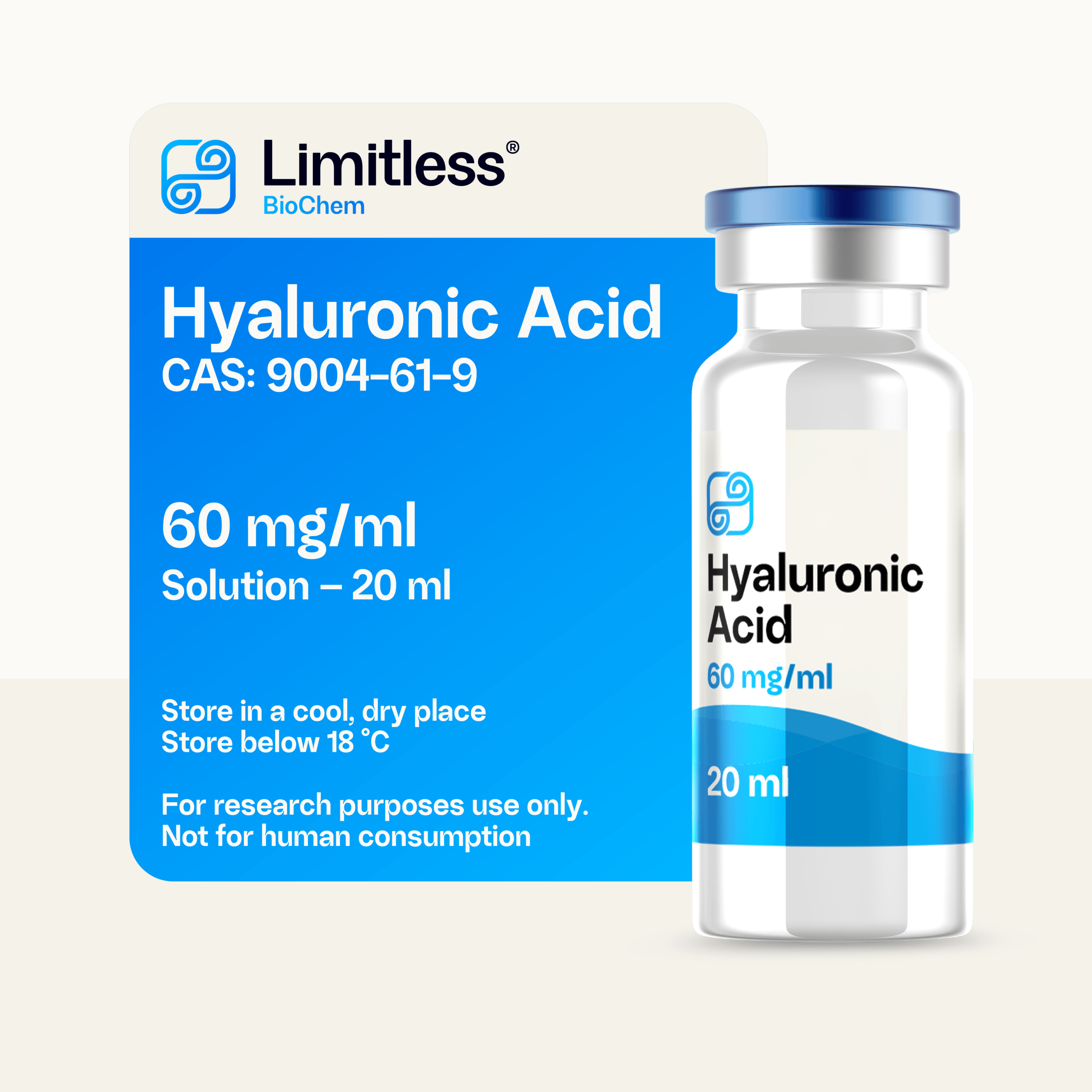
Hyaluronic Acid 60 mg/ml – 20 ml

Le prix initial était : $85.00.Le prix actuel est : $80.00.

Buy Hyaluronic Acid

Hyaluronic Acid 60 mg/ml research-grade solution in a 20 ml glass bottle. Commonly used in laboratory environments for studying extracellular matrix structure, hydration dynamics, viscoelasticity, and cell–matrix interactions.

Research Use Only: All products are intended exclusively for laboratory and scientific research. Not for human or veterinary use.


Purity
High-purity research grade
Form
Solution
Content
60 mg Hyaluronic Acid per 1 ml
Packaging
20 ml glass bottle with sterile closure
Storage
2–8 °C, protect from light
Molecular Formula
(C14H21NO11)n
Molecular Weight
Variable (polymeric)
IUPAC Name
Poly(β-1,4-D-glucuronic acid-β-1,3-N-acetyl-D-glucosamine)
CAS Number
9004-61-9
Hyaluronic acid is a naturally occurring sugar molecule (a glycosaminoglycan) in the human body that acts as a powerful humectant, meaning it attracts and retains large amounts of water—up to 1,000 times its weight. [1, 2, 3]
Where It Is Found in the Body
  • Skin: Provides volume, structure, elasticity, and dewy hydration.
  • Joints: Acts as a fluid lubricant and shock absorber in the synovial fluid between bones.
  • Eyes: Helps maintain moisture and is used in surgical eye procedures. [1, 2, 3, 4, 5]
Key Uses and Benefits
  • Skincare (Serums & Creams): Plumps the skin, reduces the appearance of fine lines, and hydrates the surface. Despite having “acid” in its name, it does not exfoliate or peel the skin.
  • Dermal Fillers: Injected under the skin to restore lost volume and soften deep wrinkles.
  • Joint Injections: Used by doctors as intra-articular injections to help ease knee osteoarthritis pain.
  • Eye Drops: Used to treat dry eyes. [1, 2, 3, 4, 5, 6]
How It Works
  • Not an exfoliant: It draws and holds moisture rather than removing dead skin cells.
  • Molecular weight matters: Smaller molecules can penetrate deeper into the skin layers for long-term hydration, while larger molecules stay on the surface to form a moisture-locking barrier.
  • Natural decline: Your body produces less hyaluronic acid as you age, which contributes to drier skin and wrinkles. [1, 2, 3]
If you are looking to use hyaluronic acid, let me know if you are interested in skincare routines, dietary sources, or medical treatments like fillers or joint injections, and I can provide more specific details.

What does hyaluronic acid do for your face?

Hyaluronic acid is a powerful humectant—a substance that acts like a moisture magnet—that attracts and binds water to the skin, holding up to 1,000 times its weight in water.

The Ordinary +4
Key Benefits for Your Face
    • Deep Hydration: It pulls moisture into the outer and deeper layers of the skin, keeping cells hydrated.
    • Plumps the Skin: The influx of moisture temporarily fills out and swells the skin tissue, creating a smoother, tighter appearance.
    • Reduces Fine Lines: By plumping dehydrated skin, it minimizes the look of fine lines and dry wrinkles.
    • Improves Texture and Softness: It helps maintain a supple, flexible, and glowing complexion
      .
  • Safe for All Skin Types: It is gentle and lightweight, making it suitable for dry, oily, sensitive, or acne-prone skin.
    Cleveland Clinic +6
How to Use It Effectively
  • Apply to Damp Skin: Put your hyaluronic acid serum on slightly wet or damp skin so it has water to draw inward.
  • Seal It In: Always follow up immediately with a moisturizer or facial oil containing an occlusive (like shea butter or petrolatum) to lock the moisture into your skin and prevent it from evaporating.
  • Frequency: You can use it safely once or twice a day, morning and night.

Buy Hyaluronic Acid


Research Overview

Hyaluronic Acid (HA) is a naturally occurring linear polysaccharide and a fundamental structural component of the extracellular matrix. In laboratory research it is widely used for studying water-binding capacity, viscoelastic properties, cellular adhesion, wound-healing models, and biomechanical characteristics of hydrated tissues.

Primary Research Areas

  • Extracellular matrix & hydration studies: widely used to investigate tissue hydration, osmotic balance, and structural organization of connective tissues.
  • Cell–matrix interaction models: applied in research exploring cell adhesion, migration, proliferation, and mechanotransduction.
  • Wound-healing & regeneration studies: used in in-vitro environments examining repair processes, angiogenesis markers, and tissue remodeling dynamics.
  • Viscoelasticity & biomechanical properties: evaluated in research where structural stability, lubrication, and load-bearing capacity of hydrated matrices are relevant.

Why Limitless Biochem Shop?

Limitless BioChem is a trusted supplier of research compounds. Our products meet strict quality standards and are compliant with EU requirements. We focus on the safe and reliable supply of peptides and pure compounds intended exclusively for research or collector purposes.

This product is not intended for human or veterinary use. It is for collection or research purposes only. It cannot be used as food, dietary supplement or medicine! The information provided in the text on this page is for educational purposes only and does not constitute medical or other advice.

Avis

Il n’y a pas encore d’avis.

Soyez le premier à laisser votre avis sur “Hyaluronic Acid 60 mg/ml – 20 ml”

Votre adresse e-mail ne sera pas publiée. Les champs obligatoires sont indiqués avec *

Panier

Save to list